Business owners · Free guide
What is AI, in plain English?
How AI tools really work, where they save a small business time, and where they trip up. No jargon. No hype.
What you will get: You can explain AI to a colleague in two minutes, and catch hype and mistakes before they reach a customer.
The key points
- AI chat tools such as ChatGPT, Claude, Gemini and Microsoft Copilot run on large language models. They write by predicting a likely next word, one piece at a time, so they can sound sure and still be wrong.
- There are three ways to use AI. Chat: you ask, you check. Automation: set steps run by themselves. Agents: given a goal, they pick the steps within limits you set. The more it acts on its own, the clearer your rules need to be.
- AI's most common mistakes are made-up facts, wrong sums, out-of-date knowledge and agreeing with leading questions. The UK's National Cyber Security Centre warns that large language models can "hallucinate" incorrect facts.
- What you type into a public AI tool is visible to the company that runs it, so keep customer and staff details out of free tools.
- Using AI doesn't switch off data protection law. Which law applies depends on where you and your customers are, and sometimes on your size: for example the GDPR in the EU (and the UK GDPR in the UK), PIPEDA in Canada, the Privacy Act in Australia, and state laws such as California's CCPA in the US. Use only the data you need and take names out before you paste. General guidance, not legal advice. Check the rules where you operate.
- The safest everyday uses are "draft first, a person checks" jobs: quote emails, review replies, meeting actions, property listings and spreadsheet formulas.
- Across the EU, about 1 in 5 businesses with 10 or more staff used AI in 2025, and 17% of small firms (Eurostat). Most small businesses are still near the start, so you are not behind.
Inside the guide
- How AI writes: it predicts the next word
- Chat, automation and agents
- What AI gets wrong, and how to catch it
- Customer data and AI: data protection basics
- 10 everyday uses, by role
- The 10-point safe-use checklist
- The 20-term glossary
- Your next step, and sources
Who it is for
- Small business owners who are new to AI
- Staff who've been asked to "look into AI"
- Anyone who wants plain answers, not hype
Sources
- Eurostat, Use of artificial intelligence in enterprises (data extracted December 2025)
- National Cyber Security Centre (UK), ChatGPT and large language models: what's the risk?
- European Commission, Principles of the GDPR
- European Commission, Legal grounds for processing data (sensitive data)
- European Commission, Obligations (when a DPIA is required)
- ICO (UK), When do we need to do a DPIA?
- Office of the Privacy Commissioner of Canada, PIPEDA
- OAIC (Australia), The Privacy Act
- California Department of Justice, California Consumer Privacy Act (CCPA)
- Advertising Standards Authority (UK), Regulating the illusion of intelligence in ads, 27 August 2026
- US Federal Trade Commission, FTC Announces Crackdown on Deceptive AI Claims and Schemes, 25 September 2024
More free guides
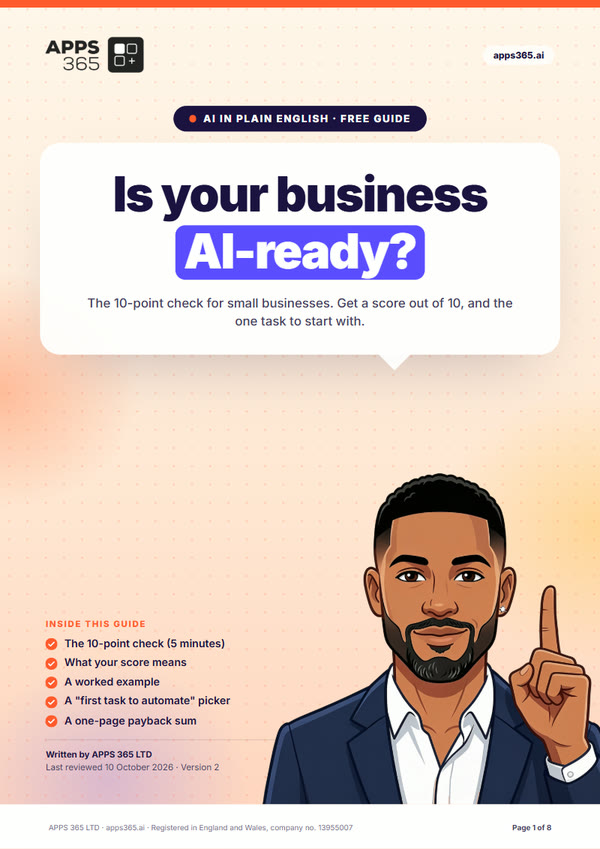 Is your business AI-ready? The 10-point check for small businessesYou get a score out of 10, the gaps to close, the one task to start with, and a rough payback figure in your currency.
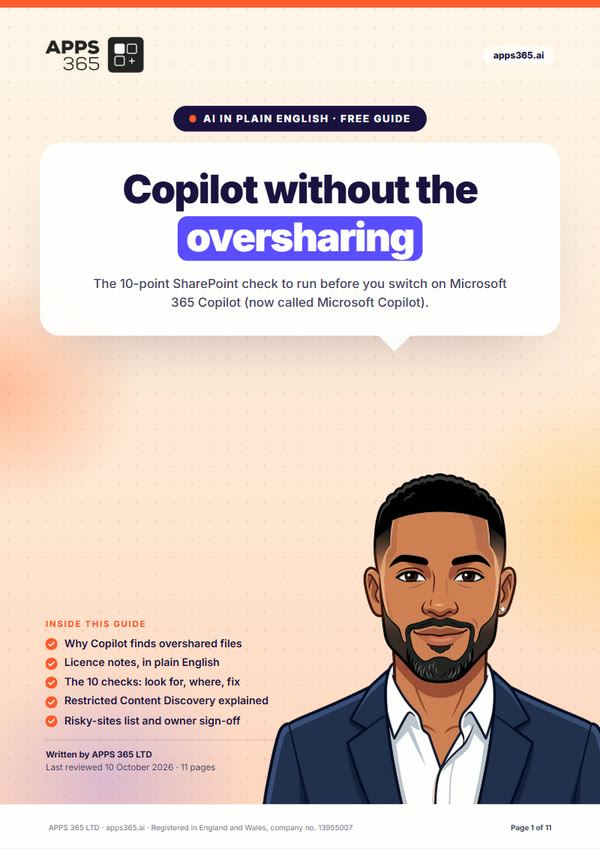 Copilot without the oversharing: the 10-point SharePoint checkYou get a list of risky SharePoint sites, who fixes each one and by when, and a signed sign-off from each site owner.